Learn how to trade cryptocurrency: a practical guide for beginners
Key Takeaways
A careful first trade starts with understanding what you are trading and deciding how much risk you can accept. Build a repeatable process before you commit meaningful capital.
- Trading aims to act on price movements; investing and holding usually take a longer view.
- Compare platforms on the assets offered, costs, security and the type of trade you will make.
- Write down entry, exit and invalidation conditions before placing an order.
- Size each position around a loss limit you can afford, and treat leverage with caution.
- Review your decisions consistently; a single profitable or losing trade does not prove a strategy works.
Understand how cryptocurrency trading works
To learn how to trade cryptocurrency, first get clear on what a trade actually involves. You might buy and sell coins directly, or use a product that tracks a coin’s price without transferring ownership of it. The available choices depend on the platform and the instrument, so check the details before you begin. Either way, your decisions happen in a market where prices can change quickly.
Trading versus investing and holding
Trading usually involves opening and closing positions to respond to price movements over a chosen timeframe. Investing and holding generally mean keeping an asset for longer, with less frequent buying and selling. The distinction is not just how long you stay in a position: it also affects how often you need to monitor the market and how you think about costs, volatility and exits. A broader trading process can help you place crypto decisions within a consistent approach to markets.
Spot markets, crypto pairs and price movements
In a spot market, you buy or sell the cryptocurrency itself, subject to the platform’s arrangements for custody and withdrawal. A crypto pair compares the value of one asset with another, such as a cryptocurrency against a fiat currency or another crypto asset. If the quoted price rises, the first asset has gained value relative to the second; if it falls, it has lost value. Some platforms also offer derivatives, where you trade price movements without owning the underlying coins, so check which kind of exposure an order creates.
Volatility, liquidity and market hours
Crypto markets often trade around the clock, including weekends, but activity and liquidity can vary by asset and time. Volatility describes how sharply and quickly prices move, while liquidity describes how readily you can trade without significantly affecting the price. In a thin market, a seemingly modest order may fill at a worse price than expected. Those conditions make it sensible to check the order book and spread rather than assuming a displayed price is guaranteed.
Common order types and what they do
An order type determines how you ask a platform to execute a trade. A market order prioritises execution at the best available prices, while a limit order sets a price boundary and may not fill. Stop orders can be used to trigger an action when a specified price is reached, though execution and slippage depend on the platform and market conditions. This comparison can help you choose an order that fits your purpose:
| Order type | What it does | Main consideration |
|---|---|---|
| Market | Seeks execution at available prices | The final fill price can differ from the quote |
| Limit | Sets the price at which you are willing to trade | The order may remain unfilled |
| Stop | Triggers an order after a specified price is reached | The resulting execution price may vary |
Use the order type that matches your plan, not simply the one that looks quickest. Before submitting anything, check whether the order is for buying or selling, the quantity, and any fees shown by the platform.
Choose a suitable platform and cryptocurrency
A platform should suit the instrument you want to trade, your experience and the way you plan to manage funds. Crypto access does not necessarily mean direct ownership of coins; some services offer exposure through other instruments. Check fees and protections in the relevant terms rather than relying on a headline feature. If you are comparing options, begin with what you need to do and verify that the platform supports it.
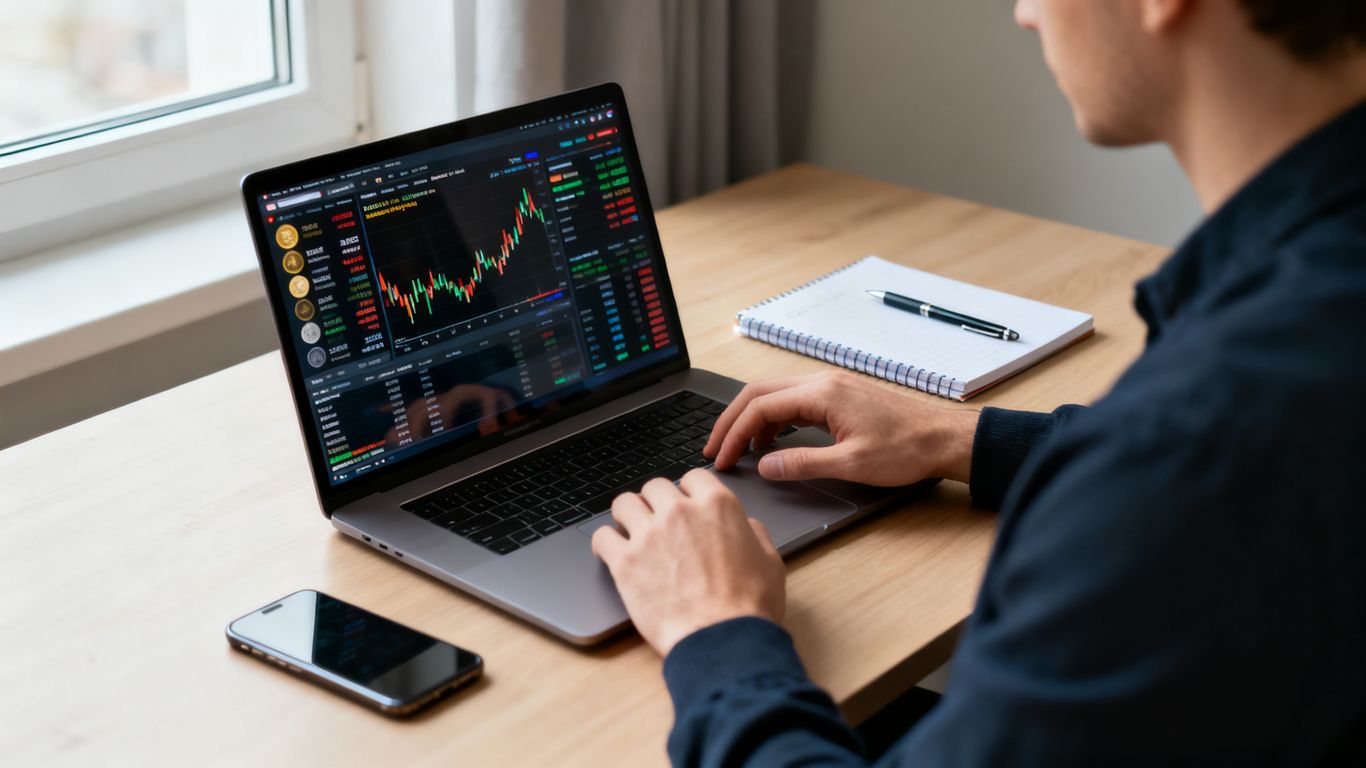
Compare exchanges, fees and available features
Compare the full cost of a trade, not only a stated commission: spreads, deposit or withdrawal charges and any funding costs may also matter. Then check which cryptocurrencies and order types are available, and whether the platform offers spot trading or a derivative. GoldFunding is a proprietary trading firm that provides traders with access to capital through an evaluation process; cryptocurrencies are among the instruments available on its accounts. Its trading platform is MatchTrader, so read the account terms to understand the product and conditions before deciding whether it suits your needs. You can also review funding options if you are researching an evaluation route rather than a standard exchange account.
Check custody, security and regulatory protections
Find out who holds any coins you buy, how withdrawals work and what protections apply if the platform fails or your account is compromised. In the UK, check the relevant firm and permissions using the FCA’s official register, and read current warnings and consumer guidance. Crypto-related products may not have the same protections as conventional bank deposits or regulated investments. Keep your own records of what you agreed to, including fees, custody arrangements and any limits on withdrawals.
Start with assets you can research and understand
A familiar name is not a substitute for understanding an asset’s purpose, supply, market depth and risks. Begin with a small number of assets and read more than promotional material: consider the project’s documentation, how its market trades and what could change demand. Beginner-friendly crypto market basics can give you a starting point for learning terms and distinctions. Avoid taking a position simply because an asset has recently risen or someone online sounds certain.
Consider whether a demo account could help
A demo account or simulator can let you practise placing orders and following a plan without putting real money at stake. It can be useful for learning an interface, but simulated fills may not reproduce live spreads, slippage or the emotional pressure of real losses. Use the practice period to test whether your rules are clear and workable, rather than to chase a high score. When you move to a live account, start small enough that mistakes remain manageable.
Build a trading plan before you begin
A written plan turns a trade from an impulse into a decision you can later assess. It should define what you are trying to do, how much time you can give it and what would show that the idea is wrong. Keep the rules simple enough to follow when prices move quickly. A plan cannot remove uncertainty, but it can help you avoid changing your approach in the heat of the moment.
Set clear goals and a realistic time commitment
Decide whether your aim is to learn order mechanics, practise a particular setup or trade a defined market condition. Avoid setting a target based on a promised return; no outcome is assured. Consider when you can realistically review positions, as a strategy that needs frequent attention may not suit an irregular schedule. If you cannot monitor a position as planned, choose a less demanding approach or wait.
Choose a trading style that fits your experience
Short-term approaches require frequent decisions and can be affected by spreads and rapid price changes. A slower swing-style approach may involve holding a position longer and tolerating larger interim moves. Neither is automatically better; the right fit depends on your available time, understanding and ability to manage risk. Start with one style and one or two setups, rather than changing methods after every result.
Define entry, exit and invalidation conditions
Before entering, write down what evidence would prompt you to open a position, where you expect to close for a gain, and what price action would invalidate the idea. This makes it easier to distinguish a planned exit from a reaction to discomfort. Set the exit conditions before the entry whenever possible; write the exit first if you tend to focus only on getting into a trade. Then check that the potential loss is acceptable if the idea fails.
Keep a written record of your rules
A trading journal makes it possible to review decisions instead of relying on memory. For each trade, record the details that explain what you did and why. A short, consistent template is more useful than an elaborate one you abandon after a few days:
- The reason for entering and the evidence you used.
- Your planned entry, exit and invalidation levels.
- The position size and maximum planned loss.
- The result, including whether you followed your rules.
After recording a trade, note one specific lesson or question to revisit. Over time, this helps you see whether the issue is the idea itself, execution or a departure from your plan.
Research the market and assess trade ideas
Research is not a way to know what the price will do next; it is a way to make your assumptions visible. Combine price information with relevant news and market conditions, and consider what evidence would change your view. Before entering, check whether the market can support the order size you intend to place. A clear idea should include both a reason to act and a reason to stand aside.

Use charts to identify trends and key price levels
Charts can help you see whether price has been making higher or lower swings, moving sideways, or reacting repeatedly near a level. Support and resistance are areas to observe, not guarantees that price will turn there. Use a timeframe that matches how long you expect to hold the position, and avoid treating a brief move on a small chart as decisive evidence about a longer trend. Mark levels before trading so that you are not moving them to justify a position already open.
Understand how news and market sentiment can affect prices
Regulatory developments, technology changes, market-wide risk appetite and influential announcements can all affect sentiment around crypto assets. A headline may already be reflected in the price, and the initial reaction can reverse as participants interpret it. Check the timing and source of news, and consider whether a planned trade depends on an event you cannot assess reliably. A crypto trading guide can help you review basic market concepts before weighing a particular catalyst.
Treat commentary and forecasts as inputs to question, not instructions to follow. If a trade idea depends on one prediction being right, decide in advance what you will do if the market moves the other way.
Check liquidity and spreads before placing an order
The spread is the difference between the available buying and selling prices, and it is one part of the cost of entering and exiting. Lower liquidity can widen spreads and make large orders harder to fill near the displayed price. Check the order book or quoted spread close to the time you intend to trade, especially during fast markets. If the cost or likely execution is unclear, reducing the order size or not trading may be the more sensible choice.
Avoid relying on a single indicator or prediction
An indicator summarises past or current price data in a particular way; it does not forecast with certainty. If several signals all derive from similar price inputs, they may not provide independent confirmation. Consider the broader market structure, the event context and your planned risk alongside any indicator. When evidence conflicts, waiting for a clearer setup is a valid decision rather than a missed obligation.
Manage risk and protect your capital
Risk controls matter because a correct market view can still lose money through poor sizing, costs or timing. Decide in advance what loss you can accept on an individual trade and across a period of trading. Then make sure your position size and exit plan fit that limit. There is no method that removes the possibility of loss, particularly in volatile crypto markets.
Decide how much you can afford to lose
Use money you can afford to lose without affecting essential bills, borrowing commitments or emergency savings. Decide on a maximum loss per trade and a broader limit at which you will stop and review your approach. A string of small losses can add up, so consider cumulative exposure rather than treating every trade as unrelated. If the risk feels stressful before you enter, reduce the amount or do not take the trade.
Size positions around your risk limit
Position size should follow from the distance between your entry and the point where your trade idea is invalidated, not from the amount of capital available in the account. A wider stop generally means a smaller position if the planned cash risk is to remain the same. Fees and possible slippage can also increase the realised loss, so leave room for them. Work through the calculation before submitting an order, and do not increase size simply to recover a previous loss.
Use stop-loss orders carefully
A stop-loss can trigger an exit when a specified price is reached, but it does not guarantee a particular execution price. Fast moves, gaps in available liquidity or the order’s settings can affect the result. Set a stop where the trade idea is invalidated, rather than placing it so tightly that ordinary price movement is likely to trigger it. Confirm whether the platform uses a stop-market or stop-limit order and understand how each behaves before relying on it.
Understand leverage and liquidation risks
Leverage increases market exposure relative to the funds committed, which can magnify both gains and losses. If the market moves against a leveraged position, the platform may close it once its margin requirements are no longer met. That can happen quickly in volatile conditions, and additional funds may not be available in time to prevent liquidation. If you are new to trading, understand the margin terms fully and consider avoiding leverage while you learn.
Place and manage your first trade
Your first live trade is a chance to follow a process, not a test of whether you can predict the market. Slow down at each step: check the account, confirm the instrument, review the order and make sure the maximum planned loss remains acceptable. If any detail differs from your plan, pause before submitting. A small, deliberate first position can teach you more about execution than a large one.
Fund your account and check the transaction details
Use a payment method and account in your own name, and check deposit terms, processing times and possible charges before transferring funds. Confirm whether you are depositing money for a spot purchase or funding an account that provides exposure through another instrument. Check the asset, direction, quantity and order settings on the confirmation screen. Do not proceed if the transaction details or destination are unclear.
Choose between market and limit orders
A market order is generally used when execution matters more than a precise price, but the fill may differ from the last price displayed. A limit order controls the price you are willing to accept, though it may not execute at all. Consider liquidity and urgency as well as fees when choosing. Once you have selected the order type, review the full order preview rather than assuming the interface has retained your intended settings.
Monitor an open position without overreacting
Follow the monitoring routine in your plan rather than watching every price movement. Check whether the original reason for the trade still holds and whether any planned exit condition has been reached. Avoid widening a stop or adding to a losing position solely because you hope the price will turn. If new information changes the trade thesis, respond according to a rule you can explain, not an urge to avoid accepting a loss.
Close the trade and review the outcome
Close the position when a planned exit is reached, the idea is invalidated or your rules otherwise require it. Confirm whether the platform has closed the entire position and review the final execution and costs. Record the result alongside whether you followed your process; a winning trade that broke your rules still deserves scrutiny. Likewise, a loss taken according to plan does not by itself mean the decision was poor.
Protect your account and keep improving
Good trading habits include protecting access to your account and keeping reliable records. Account security is your responsibility even when a platform provides safeguards. Build a routine for checking transactions, saving statements and reviewing your decisions. Small, repeated improvements are more useful than changing everything after one disappointing outcome.
Use strong passwords and two-factor authentication
Use a unique, long password for each financial account and store it in a reputable password manager. Turn on two-factor authentication where available, preferably using an authenticator app or security key rather than relying only on text messages. Never share login codes or approve a sign-in you did not initiate. Be cautious of urgent messages that ask you to click a link or disclose account details.
Store crypto safely and check withdrawal addresses
If you own coins, understand whether they are held by a service or transferred to a wallet you control, and learn the responsibilities that come with self-custody. Back up recovery information securely and never share a private key or recovery phrase. Before sending crypto, check the address and network carefully; an incorrect transfer may be difficult or impossible to reverse. For a first withdrawal, consider verifying the process and any charges with a small test transaction where appropriate.
Keep records and understand UK tax responsibilities
Keep statements and records of purchases, sales, transfers, fees and the dates involved. UK tax treatment depends on your circumstances and the kind of activity you undertake, so do not assume every crypto transaction is treated the same way. Check current HMRC guidance and seek qualified tax advice if you are unsure. Clear records make it easier to explain what happened and assess any reporting responsibilities.
Review your decisions and learn from mistakes
Set aside time to review a group of trades rather than judging your approach on one result. Look for repeated patterns: whether you entered too early, sized too large, ignored a planned exit or followed your rules well. Change one part of your process at a time, then observe whether the adjustment helps. Learning also means recognising when a setup is not working and stepping away until you have reviewed it.
Explore funded trading
If you have a tested approach and want to explore access to capital through an evaluation, GoldFunding provides that route for traders who prove their skills through its process; review the terms and risks before deciding whether it fits you.
Conclusion
Learning to trade cryptocurrency is less about finding a perfect prediction than building a process you can explain and repeat. Understand the instrument, check the costs, set risk limits before entry and review your decisions honestly. Start cautiously, keep learning and be prepared to wait when a trade does not meet your rules.
Frequently Asked Questions
Can you trade cryptocurrency 24 hours a day?
Many crypto markets operate around the clock, including weekends, though liquidity and trading conditions vary. Check the specific platform’s hours and the asset’s market activity.
How much money do you need to start trading crypto?
The minimum depends on the platform and instrument. Begin only with money you can afford to lose, and check minimum order sizes, fees and any funding requirements before depositing.
Is buying cryptocurrency the same as trading it?
Not always. Buying on a spot market generally means purchasing the asset, while some trading products provide exposure to price movements without transferring ownership. Confirm which instrument you are using.
What is the difference between a market order and a limit order?
A market order seeks execution at currently available prices, while a limit order sets a price boundary and may not fill. The appropriate choice depends on your priorities and market conditions.
Is cryptocurrency trading risky?
Yes. Prices can move sharply, and you may lose some or all of the money you commit. Leverage, low liquidity, security failures and operational issues can add further risks.
Should beginners use leverage to trade crypto?
Leverage can magnify losses as well as gains and may lead to liquidation if margin requirements are not met. Beginners should understand the terms fully and may choose to avoid leverage while learning.
Do you pay tax on cryptocurrency trading in the UK?
Tax treatment depends on your circumstances and the transactions involved. Keep accurate records, check current HMRC guidance and consult a qualified tax adviser if you need advice about your situation.