Trading and forex: a practical guide to strategies, risk and funded accounts
Key Takeaways
Trading and forex become easier to approach when you understand the market, choose a method that suits your routine, and define risk before you enter.
- Currency pairs move in response to economic expectations, interest rates, sentiment and liquidity.
- Your trading style should fit your available time, temperament and tolerance for losses.
- Position size, stop-loss placement and drawdown awareness matter more than a single winning trade.
- Rapid is a one-step evaluation, while Classic uses two phases to assess consistency.
- Rules around daily loss, best days, news and automation must be checked before trading.
Understanding trading and forex fundamentals
Trading and forex involve exchanging one currency for another while managing price risk. You are not simply guessing whether a chart will rise or fall; you are assessing a market, defining an entry and deciding how much you can afford to lose. A sound foundation helps you interpret strategy results without confusing luck with skill. For a beginner-friendly introduction, IG also offers a step-by-step explanation of currency trading.
How the forex market works
Forex is a decentralised global market in which currencies are quoted in pairs. When you trade EUR/USD, for example, you are comparing the euro with the US dollar: the first currency is the base and the second is the quote. If the pair rises, the base currency has strengthened relative to the quote currency, or the quote currency has weakened.
Prices are available through a network of banks, liquidity providers and brokers rather than one central exchange. Trading activity follows the major financial centres, so liquidity and volatility can change as London, New York and Asian sessions overlap. That rhythm matters when you decide whether a strategy suits quiet periods or fast-moving markets.
Major, minor and exotic currency pairs
Major pairs typically include the US dollar alongside currencies such as the euro, pound, yen or Swiss franc. They tend to attract substantial trading interest, although that does not remove the possibility of sharp moves or losses. Minor pairs exclude the US dollar, while exotic pairs combine a major currency with one from a smaller or emerging economy.
The category can influence spread, liquidity and execution conditions. A pair with a wider spread may require a larger move before your trade becomes profitable, so you should include trading costs in your plan rather than judging a setup from the chart alone.
What moves exchange rates
Exchange rates respond to changing expectations. Interest-rate decisions, inflation, employment data, political developments and central-bank communication can all alter how traders value a currency. Risk appetite matters too: when markets become nervous, demand may shift towards currencies perceived as defensive, while optimistic conditions can favour risk-sensitive assets.
Economic releases are not automatically trade signals. The result, the forecast and the previous figure can all matter, and the first price reaction may reverse within minutes. A useful economic news guide can help you put scheduled events into context, but you still need a defined risk plan.
Key terminology every new trader should know
You will encounter a small set of terms repeatedly. The spread is the difference between the bid and ask price; leverage allows you to control a larger position with less upfront margin, while increasing the impact of price movements. A pip is a common unit for measuring a currency pair’s movement, though its value depends on the pair and position size.
Margin is the amount set aside to support a position. Equity reflects your balance plus or minus unrealised profit and loss, which is why an open trade can affect a loss limit before it is closed. These distinctions become practical rather than theoretical when you are monitoring drawdown.
Choosing a forex trading strategy
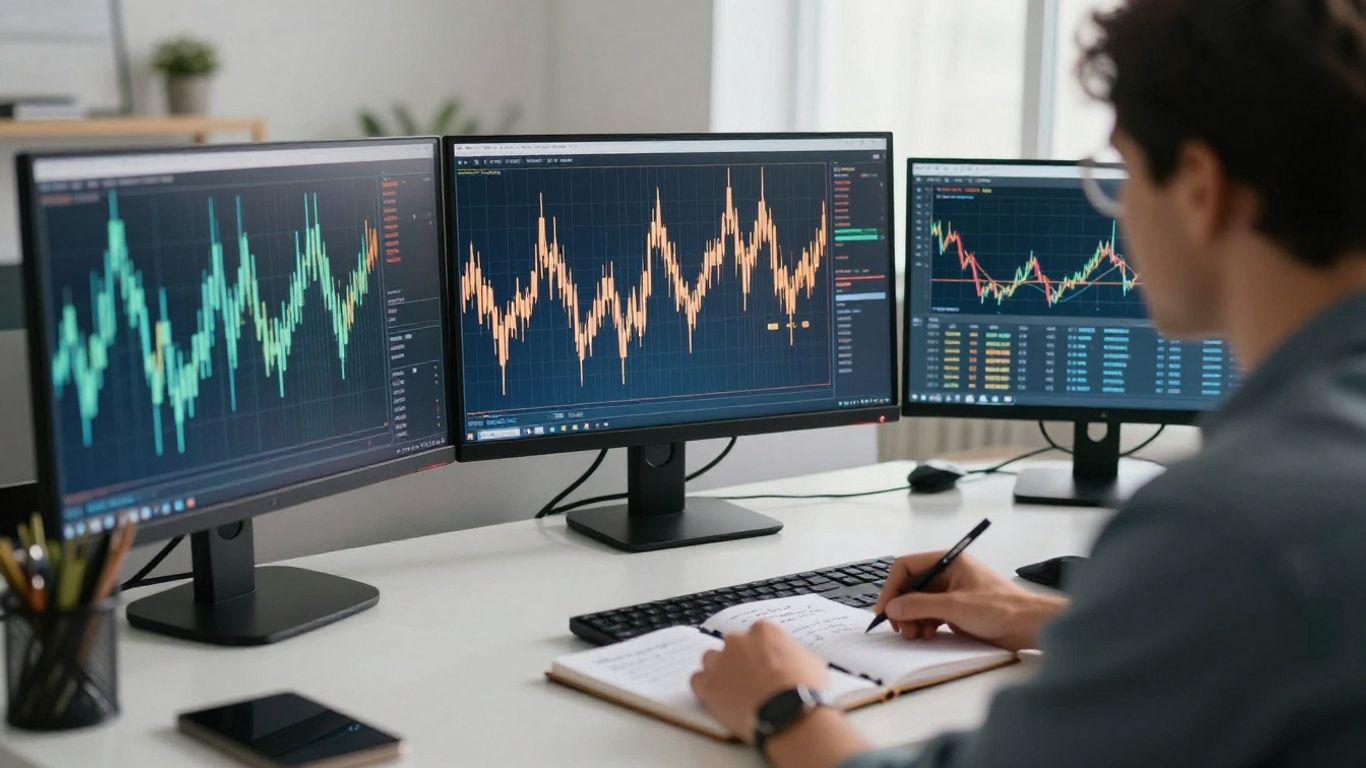
A strategy is a repeatable way of deciding when to enter, manage and exit trades. It does not need to be complicated, but it should be specific enough for you to review later. You can compare different approaches through forex strategy research, then test one method without changing its rules after every losing trade.
Day trading, swing trading and scalping
Day trading generally means opening and closing positions within the same trading day. Swing trading may hold a position for several days or longer to capture a broader move, while scalping seeks smaller movements through frequent trades. None is automatically safer; the relevant question is whether the pace fits your attention, capital and decision-making habits.
A fast style can create more opportunities but also more chances to make execution mistakes. A slower approach gives you more time to plan, though overnight events can change the position while you are away from the screen. Pick a pace you can follow consistently, not the one that sounds most exciting.
Technical analysis and price action
Technical analysis uses price, volume where available, support and resistance, trends, ranges and indicators to frame a possible trade. Price action focuses more directly on how candles and market structure behave. Either approach can provide rules for entries and exits, but neither can remove uncertainty.
You might define a trend, wait for a pullback and enter only if price confirms your condition. The useful part is not the indicator itself; it is the decision rule around it. Record why the setup qualified, where it failed and whether the result followed your plan.
Fundamental analysis and economic events
Fundamental analysis considers the economic forces behind a currency, including monetary policy, inflation, growth and political risk. It can support a longer-term view or help you understand why a technically attractive setup may be vulnerable to a major announcement. Your analysis should distinguish a known event from your uncertain interpretation of its outcome.
Calendars, central-bank statements and reliable market coverage can help you prepare. However, a scheduled announcement can produce rapid spreads and price swings, so you should know your account’s news rules before holding a position into it. Preparation is more useful than trying to predict every headline.
Matching a strategy to your risk tolerance and schedule
Your method should fit the hours you can genuinely give it and the losses you can tolerate without abandoning your rules. Someone with limited screen time may prefer fewer, planned setups, while a full-time trader may be able to monitor shorter-term entries. Consistency beats excitement when you are building evidence about a method.
Before committing, ask yourself:
- How many hours can you monitor markets without distraction?
- How many losing trades can you accept before changing the plan?
- Does the strategy depend on news, overnight holds or rapid execution?
- Can you explain the entry, stop and exit conditions in plain language?
The answers will narrow your choices. A strategy that looks impressive in a screenshot is less useful if you cannot execute it during an ordinary week.
Managing risk before placing a trade
Risk management is the part of trading you can define before the market gives you new information. It covers the amount at stake, the point at which your idea is invalid and the conditions that would make you stop for the day. In funded trading, these decisions also need to fit the account’s formal limits. The goal is not to avoid every loss, but to prevent one decision from damaging your ability to continue.
Setting position size and stop-loss levels
Position size should follow the distance to your stop-loss and the amount you are prepared to risk. A wider stop usually requires a smaller position if the cash risk is to remain similar. You should calculate this before entry, including the pair’s pip value, spread and any likely slippage.
A stop-loss is not a guarantee of an exact exit price in every market condition. It is a predefined point at which you accept that the trade thesis has failed. If you repeatedly move it further away, your original risk calculation no longer describes the position.
Understanding daily and overall drawdown
Daily drawdown measures how much your account can lose within the relevant trading day, while overall drawdown measures the broader decline from the permitted reference point. Under the documented GoldFunding limits, the daily loss limit is 5% and maximum overall drawdown is 12%, with the overall threshold locked to the initial account balance. You should read the precise calculation method, including how open equity and the daily reset are treated.
A static overall threshold does not mean risk disappears after a profitable day. Floating losses can still matter, and a profitable balance can encourage you to increase size too quickly. Check the dashboard before opening new positions and keep a private record so you are not relying on memory.
Why oversized, gamble-style trades are dangerous
An oversized position can make a single result dominate your account. Even if the trade wins, it may create an unstable pattern; if it loses, the damage can be difficult to recover without violating a daily or overall limit. The documented rules do not allow gamble-style trading, described as opening a single oversized position hoping for a one-shot win.
A trade can be aggressive without being a planned risk. Ask whether the size was calculated from a repeatable rule or chosen because you wanted to recover a previous loss. That question often reveals when a strategy has turned into emotional decision-making.
Building a repeatable risk management routine
Your routine should be short enough to use every time. Before entering, confirm the setup, size, stop, nearby event risk and remaining daily loss capacity. After closing, record the result in both money and risk units so a large position cannot look acceptable merely because it happened to win.
Reviewing a sample of trades is more informative than judging one outcome. Look for repeated errors, such as entering late, moving stops or increasing size after a loss. Small corrections made consistently can protect your account more effectively than searching for a perfect indicator.
Comparing funded forex account pathways
A funded evaluation gives you a defined route for demonstrating trading discipline against published rules. The attraction is access to capital after passing, but the assessment still requires you to manage losses, timing and consistency. GoldFunding provides two documented pathways: Rapid, which uses one phase, and Classic, which uses two. Compare the structure rather than choosing solely by the headline target.

How a one-step Rapid evaluation works
Rapid is a one-step evaluation. You complete the GoldFunding Challenge by reaching a 10% profit target while respecting the 5% daily loss limit and 12% maximum overall drawdown. Once you pass the evaluation, you become a funded trader under the applicable funded-account requirements.
The single phase may appeal if you already have a tested process and want a shorter assessment structure. It does not remove the need for controlled sizing: the same drawdown limits apply, and the 40% best day rule still affects how profits are distributed.
How the two-step Classic evaluation works
Classic uses the GoldFunding Challenge followed by a Verification phase. The documented targets are 10% in the Challenge and 5% in Verification, while the daily and overall drawdown limits remain 5% and 12%. It is positioned as a lower-cost route that rewards consistency over two stages.
The extra phase gives you another opportunity to demonstrate that your results were not produced by one unusual session. It also means you must manage time and risk across separate requirements rather than treating the first target as the whole assessment.
Profit targets and phase requirements
Targets are only one part of the assessment. You must also understand the minimum active-day requirement, the time limit and the best-day calculation. The following summary keeps the main differences visible, but you should check the current terms before purchasing an account.
| Pathway | Phases | Profit targets | Core loss limits |
|---|---|---|---|
| Rapid | 1 | 10% | 5% daily, 12% overall |
| Classic | 2 | 10%, then 5% | 5% daily, 12% overall |
| Both pathways | Per phase | Minimum 7 active days by default | 30-day target period by default |
The table is a planning aid, not a substitute for the full rules. Add-ons may change the minimum-day or maximum-day settings, while the drawdown limits remain central to the assessment. Build your trading calendar around the rules you have actually selected.
Choosing between speed, cost and consistency
Rapid may suit you if a one-phase structure matches a mature process. Classic may suit you if you prefer a second verification stage and a lower-cost route that tests consistency across phases. Neither structure makes a weak strategy reliable, and neither changes the need to protect downside.
Think in terms of execution quality. A pathway should leave you enough room to trade normally, rather than encouraging oversized positions simply to reach a target quickly. The cheapest or fastest choice is not necessarily the most appropriate one for your behaviour.
Navigating trading rules and restrictions
Rules are part of the trading environment, not paperwork to read after a breach. You need to know what counts as a trading day, when the daily limit resets and whether a position may remain open through an event or weekend. Read the account terms alongside your strategy so the two do not conflict. If a rule is unclear, ask support before placing a trade.
The 40% best day rule
The 40% best day rule means no single trading day can produce more than 40% of the profit target during evaluation, or more than 40% of total profit in a funded payout cycle. It applies to both evaluation and funded accounts. It is described as a soft breach: you do not automatically fail, but you continue trading until the profit is spread sufficiently to pass or request a payout.
This makes a steady process preferable to a dramatic one-day result. If you have a large winning session, avoid trying to force another large session immediately. Continue only when your normal setup appears and let the distribution improve naturally.
Minimum trading days and time limits
The default requirement is at least seven active trading days per evaluation phase, with 30 days to reach the profit target. The No Minimum Days add-on can remove the seven-day requirement, while Double Max Days can extend the maximum period to 60 days. These settings affect your planning, so confirm what applies to the account at checkout.
A minimum-day rule should not push you into low-quality trades. You can use the time to observe, take only valid setups and document your decisions. If the calendar is becoming the reason for an entry, your process needs review.
Overnight, weekend and scalping permissions
The documented rules allow overnight and weekend holding without restrictions, and scalping is permitted. Permission does not mean every approach is sensible for your account. A position held through a quiet period can still face a gap or an unexpected move, while frequent trades can accumulate costs and execution errors.
Choose holding periods deliberately. If you keep positions open, know the margin and event risks; if you scalp, monitor your concentration and daily loss closely. The freedom to trade is not a reason to trade continuously.
News trading restrictions around high-impact announcements
News trading is not permitted by default. The rules define restricted timing as opening or closing positions within two minutes before or two minutes after scheduled high-impact economic announcements listed in the economic calendar. The news trading add-on can enable this activity when selected before checkout.
You should monitor the calendar even if you do not trade announcements directly. A position opened earlier can still be affected by a release, and a rule breach can arise from timing rather than from your analysis. Plan exits and exposure well before the restricted window.
Using tools and automation responsibly
Tools should reduce avoidable mistakes, not replace judgement. An economic calendar can structure preparation, a journal can expose repeated errors and an automated system can apply rules consistently when permitted. Each tool also has limits: data can be delayed, records can be incomplete and automation can execute a flawed idea very efficiently.
Economic calendars for forex traders
An economic calendar lists scheduled releases that may affect currencies and related instruments. You can use it to mark periods when spreads or volatility may change, then decide whether to reduce exposure, close a position or remain flat. The calendar is a planning tool, not a prediction engine.
Check the time zone and event classification before relying on an entry rule. A missed announcement can create both market risk and a compliance problem where news trading restrictions apply. Make calendar review part of your pre-session routine.
Trading journals and performance tracking
A journal should capture more than profit and loss. Record the setup, timeframe, entry reason, planned stop, position size, event context and emotional state. Reviewing these fields helps you distinguish a bad trade from a good trade that happened to lose.
You can also track average risk, win rate, average win, average loss and adherence to your rules. The purpose is not to chase a flattering statistic; it is to find the behaviour that most needs correction. A simple spreadsheet is often sufficient if you update it honestly.
When expert advisors and algorithmic trading may help
Expert advisors and algorithmic trading can help apply prewritten conditions without hesitation, but they introduce technical and rule-based risks. A system may behave differently during spread widening, connection problems or unusual volatility. You should test its logic, monitor execution and understand how it handles stops and open positions.
For the documented evaluation rules, EAs and automated trading require the Allow Automated Trading add-on at checkout. Permission still leaves you responsible for drawdown, prohibited behaviour and the results of the system you choose to run.
Add-ons for automated trading, news access and flexible trading periods
Add-ons can change specific account conditions. The documented options include Allow Automated Trading, news trading access, No Minimum Days and Double Max Days. Treat each as a rule modification to verify, not as a shortcut to better performance.
Before checkout, write down which settings you need and compare them with your strategy. A news trader may need different access from a swing trader, while someone with a limited schedule may value more time rather than automated execution. The right choice follows from your method.
Moving from evaluation to funded trading
Passing an assessment changes the account stage, but it does not remove the need for discipline. You still need to follow drawdown limits, monitor your positions and keep clear records. Funded trading should feel like the same process at a different level of responsibility, not an invitation to increase risk without evidence.
What happens after passing an assessment
After passing the evaluation stage, the documented process provides a fresh reset funded account to start trading and earning profits on. In Rapid, this follows the one-step assessment; in Classic, it follows completion of the Challenge and Verification phases. Read the account instructions carefully before placing the first funded trade.
Your first priority should be preserving the process that passed. Do not assume that a new balance means you should immediately trade larger. Start by checking the dashboard, limits, instruments and any active account settings.
How profits and payout-cycle performance are reviewed
Funded performance is reviewed across the payout cycle as well as by individual trades. The 40% best day rule applies to total profit in that cycle, so a single outsized day can delay a payout request even when the account has made money. Profit verification also matters: live-server trades are reconciled through audited statements and checked against anti-cheating software.
Keep your journal and platform records aligned. If you cannot explain how a result was produced, it becomes harder to review your own performance and answer a compliance query. A payout cycle is not only a financial milestone; it is a record of how consistently you followed the rules.
Available markets beyond forex
A funded account may offer more than currency pairs. The documented available markets include forex, commodities, indices and cryptocurrencies, with the wider instrument reference also listing gold, silver, select US-equity CFDs and related markets. Availability can depend on the account and current terms, so check the instrument list before planning a trade.
Moving into another market changes the way you assess volatility, session behaviour and position size. Do not transfer a forex risk model mechanically to gold, crypto or an index. Test the instrument and understand its contract specifications first.
Verifying trades and following account compliance requirements
Compliance begins before entry. You should know the daily and overall limits, avoid overleveraging, follow news and automation permissions, and keep evidence of your decision-making. The firm’s stated process includes trade reconciliation and anti-cheating checks, so unusual activity or unclear records can create unnecessary questions.
A final pre-trade check can be simple: confirm the instrument, size, stop, event window, remaining loss capacity and account rule. That pause is valuable because it turns compliance from a last-minute concern into part of your normal trading routine.
Conclusion
Trading and forex reward preparation more reliably than impulse. Learn how the market moves, choose a strategy that fits your life, calculate risk before entry and compare funded pathways by their complete rules rather than their headline targets. If you treat evaluation and funded trading as exercises in repeatable decision-making, you give yourself a clearer basis for judging progress without mistaking a short run of results for certainty.
Frequently Asked Questions
Is forex trading suitable for beginners?
It can be studied by beginners, but you should first understand leverage, spreads, position sizing and the possibility of loss. Practise your process and use risk limits before committing meaningful capital.
What is the difference between a major and an exotic currency pair?
Major pairs usually involve the US dollar and heavily traded currencies, while exotic pairs combine a major currency with one from a smaller or emerging economy. Exotic pairs may have wider spreads and different liquidity conditions.
How much should you risk on one forex trade?
There is no universal figure that suits everyone. Your risk should be small enough that a normal sequence of losses does not force you to abandon your plan or breach an account limit.
What is drawdown in trading?
Drawdown is a decline in account equity or balance from a reference point. Daily drawdown applies to a defined trading day, while overall drawdown describes the broader permitted decline.
Should you trade during major economic announcements?
Only if your strategy and account rules permit it and you understand the volatility involved. Announcements can produce rapid price changes, wider spreads and difficult execution.
Are automated trading systems always reliable?
No. Automation follows its programming and can fail through flawed logic, technical interruptions or unusual market conditions. You remain responsible for testing, monitoring and complying with the relevant rules.
What should you compare before choosing a funded account evaluation?
Compare the phase structure, profit targets, drawdown limits, minimum days, time limits, news and automation permissions, holding rules and payout conditions. The best fit depends on your strategy and routine rather than one headline feature.