How to learn to trade cryptocurrency: A practical guide for beginners
Key Takeaways
Learning to trade cryptocurrency takes time; the aim at first is to understand the mechanics and practise without putting meaningful money at risk.
- Know the difference between owning crypto and trading a derivative.
- Learn how orders, fees, liquidity and volatility affect a trade.
- Write down entry, exit and risk rules before you place an order.
- Practise and review your decisions before increasing your exposure.
- Treat security, scams and possible losses as part of trading, not afterthoughts.
Understand what cryptocurrency trading involves
Cryptocurrency trading means buying and selling digital assets, or taking a position on their price, with the aim of benefiting from a price change. You can start by learning the terminology and mechanics rather than trying to predict what a coin will do next. If you are looking for a wider introduction, this guide to crypto trading basics covers market types, costs and planning. Your first useful question is what kind of exposure a trade actually gives you.
How spot trading differs from derivatives
With spot trading, you buy or sell the cryptocurrency itself; what happens to the asset after purchase depends on how and where you hold it. A derivative gives you exposure to price movements without necessarily owning the underlying coin. Some derivatives allow you to take a position on a price falling as well as rising, but terms and risks vary by product. Before trading, check whether you are buying an asset or entering a contract, and understand how settlement, custody and losses work.
What can move crypto prices and market sentiment
Crypto prices can respond to shifts in supply and demand, changes in regulation, technology developments, news and broader financial-market conditions. Sentiment can also change quickly: a burst of buying may draw in new participants, while fear or uncertainty can prompt rapid selling. These influences do not provide a reliable forecast on their own. When you study a move, ask what information was available at the time and whether the price reaction supports your interpretation, rather than explaining it only after the event.
How trading differs from long-term investing
Trading usually involves decisions over shorter periods and more frequent attention to prices, costs and risk. Long-term investing typically focuses on holding an asset over a longer horizon, though it still carries risk and requires decisions about what to own. Your available time matters: a method that needs you to monitor a market all day may not suit your routine. For additional free background on digital assets, you can explore crypto education resources, then decide whether active trading fits your goals and temperament.
Learn the essential market and order basics
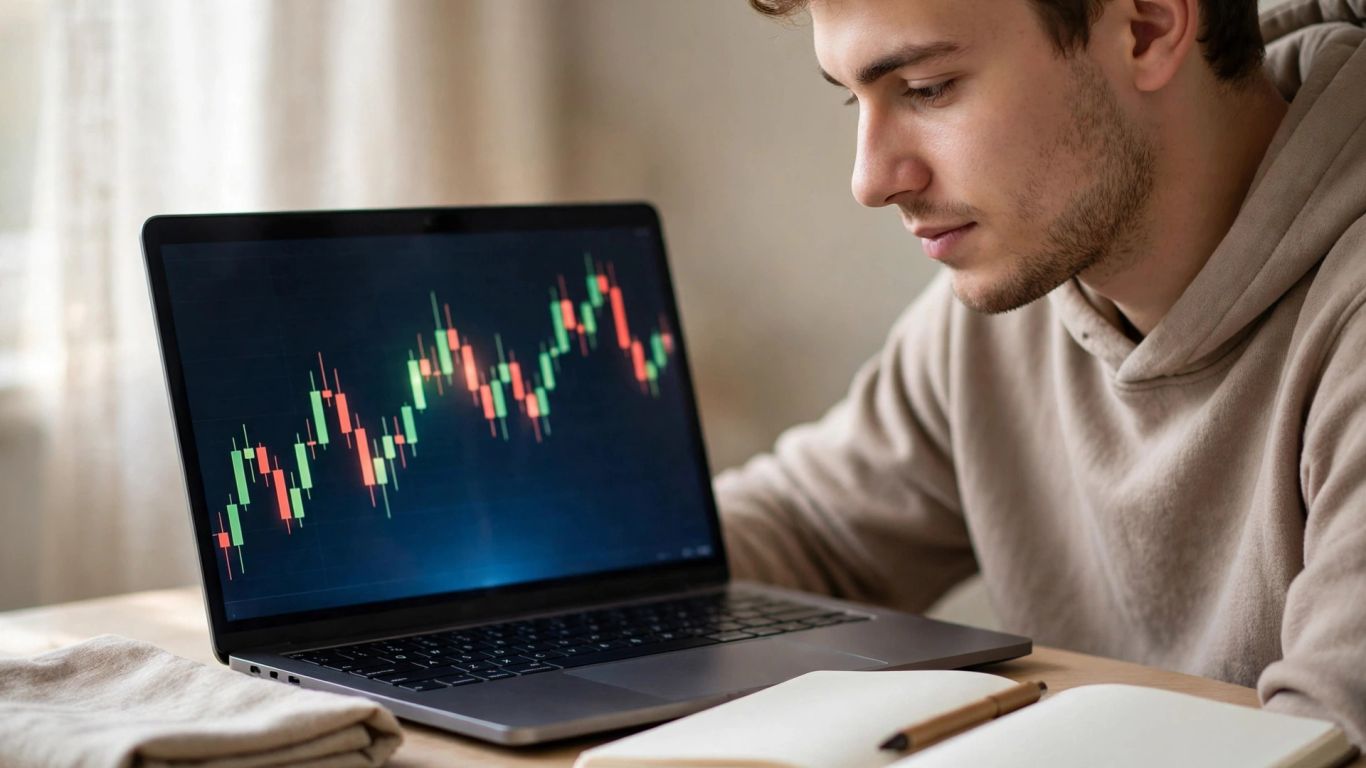
A chart is a record of past prices, not a promise about the next move. Before placing an order, learn to read the price scale, timeframe and trading pair, and check the costs and conditions that apply to that market. Start with a few familiar terms and build from there; a compact video explainer can help you see how chart elements fit together. The aim is to understand what an order will do before you send it.
How to read price charts, candlesticks and trading pairs
A candlestick summarises price movement over a chosen period, typically showing the opening, closing, high and low prices. Its shape gives you a quick record of that interval, but it does not explain why the price moved or what will happen next. A trading pair, such as BTC/USDT, shows one asset priced in another; check which asset is being bought and which is used to quote its price. Begin with one or two timeframes and avoid drawing firm conclusions from a single candle.
When to use market, limit and stop orders
Order types control how you enter or exit, but they do not remove market risk. A market order prioritises execution at the available prices, while a limit order sets the price at which you are willing to trade and may not fill. A stop order is triggered when its specified level is reached, though execution can differ from that level in fast markets. This comparison can help you choose an order to study before practising:
| Order type | What it does | Point to consider |
|---|---|---|
| Market | Seeks execution at available prices | The final price may differ from the last price you saw |
| Limit | Sets the price you are willing to accept | The order may remain unfilled |
| Stop | Triggers an order after a specified price is reached | Fast moves can affect the execution price |
The right choice depends on your objective and the market conditions, not on a label being universally better. Check the platform’s specific order behaviour, including whether a stop becomes a market or limit order, before relying on it.
How liquidity, spreads, volatility and fees affect trades
Liquidity describes how readily an asset can be traded without moving its price substantially. The spread is the gap between the available buying and selling prices, and fees add another cost; together, these can make a small price move less meaningful than it first appears. Volatility measures how sharply prices fluctuate, which can make both potential gains and losses arrive quickly. Include these costs in your practice calculations: a strategy that looks promising before fees and slippage may not hold up once realistic trading conditions are considered.
Choose a suitable platform and protect your account
A platform is part of the trading decision because it determines which markets and order types you can access, what information is shown and what it costs to trade. Take time to read its terms and security guidance before depositing money. GoldFunding is a proprietary trading firm that provides skilled traders access to capital through an evaluation process; its trading platform is MatchTrader. Those details are relevant if you later explore funded trading, but they do not replace checking whether a service and its rules fit your needs.
Compare exchanges, fees and available markets
Compare platforms by looking at the assets or instruments available, the fee schedule, order functionality, withdrawal terms and account protections. Do not assume that a displayed price includes every cost: check trading fees, spreads and any charges for moving funds. If you are considering a funded account rather than buying crypto directly, read its evaluation rules separately from exchange terms. GoldFunding lists cryptocurrencies among the instruments available to trade, alongside other markets; confirm the current terms and product details before making a decision.
Check UK rules, identity requirements and tax responsibilities
Requirements depend on the service and the activity involved. A platform may ask you to verify your identity, and UK rules can change, so check current guidance from relevant authorities before you open an account or trade. Keep clear records of transactions, fees and transfers. Tax treatment depends on your circumstances and the nature of your activity; consult current HMRC guidance or a qualified tax adviser rather than relying on a general article to decide what you owe.
Secure your account with strong passwords and two-factor authentication
Account security starts with a unique password stored in a reputable password manager and two-factor authentication where available. Use care with links in messages, keep recovery details private and never share a one-time code with someone who contacts you unexpectedly. If a service offers withdrawal controls or account alerts, learn how to use them before you need them. Security habits are part of the process of learning to trade: a sound market idea cannot protect an account from a compromised login.
Build a trading plan before risking money
A written plan turns a vague intention into a set of decisions you can review. It should say what you will trade, when you will consider a position, what would invalidate the idea and how much you are prepared to risk. Keep it simple enough to follow during a fast market. If you later compare funded routes, you can review funding options, but first make sure your own approach is defined and testable.

Set goals, choose a time horizon and focus on a few markets
Choose a time horizon that suits your schedule and decide what you want to learn before you set any financial target. Focusing on a small number of markets can help you notice how they behave across different conditions, rather than spreading your attention across a long watchlist. Write down when you can review prices and how much time you can realistically give the task. A learning goal such as following a defined process is more useful early on than expecting a particular return.
Define entry, exit and invalidation conditions
Before you enter, describe what would make the trade worth considering and what evidence would show that the idea is no longer valid. Set an exit condition for both a favourable move and an unfavourable one, and decide whether you will close the position manually or use an order. This makes it easier to distinguish a planned decision from a reaction to fear or excitement. If you cannot explain the conditions in plain language, the trade may not be clear enough to take.
Calculate position size and set clear risk limits
Position size connects your planned loss to the distance between entry and the point where your idea is invalidated. Work out the amount at risk before you enter, and include fees and the possibility that an order executes at a different price than expected. Set a personal limit for how much you can lose in a day or over a series of trades, then stop when you reach it. These limits are not guarantees against loss, but they can prevent one decision from consuming more of your available capital than intended.
Understand leverage and liquidation risk before using derivatives
Leverage lets you control a larger position relative to the funds committed, but it can magnify losses as well as gains. In some derivatives, a move against your position can trigger liquidation, closing it under the product’s rules and potentially leaving you with a substantial loss. Learn the margin, funding and liquidation terms before considering leverage; do not infer them from another platform or product. For a beginner, understanding an unleveraged position first is often a clearer way to learn how price changes affect the value of a trade.
Practise and test your approach
Practice helps you find gaps in your understanding before real money is involved. Use it to learn how orders behave, whether you can follow your rules and how the method performs across different conditions. A simulated result is not proof that a strategy will work live, where execution, emotions and liquidity can differ. Treat practice as a way to collect evidence and improve your process, not as a reason to rush into larger trades.
Try a demo account or paper trading
A demo account or paper trading lets you record hypothetical trades without placing them in a live market. Choose a consistent method for noting the entry, exit and result, and use realistic position sizes rather than numbers that would be impossible for you to trade. A simulation can help you learn an interface and practise following a plan, but it may not reproduce the pressure or execution conditions of a live trade. Judge it by what you learn, not by the size of a virtual win.
Back-test rules while accounting for fees and slippage
Back-testing means applying a defined set of rules to historical price data to see how it would have performed over that sample. Write the rules first, then test them consistently; changing the rules after each losing trade makes it hard to tell what the results mean. Include estimated fees and slippage, and remember that past data cannot include every future market condition. A useful test can reveal weaknesses, but it cannot establish that a method will remain profitable.
Keep a trade journal and review results objectively
A journal gives you a record of what you planned, what you did and what the market did next. Note the setup, entry and exit, the amount at risk, costs and whether you followed your rules. Review a series of trades rather than judging a method from one win or loss. Look for repeatable process errors—such as changing an exit in response to anxiety—then adjust one part of your approach at a time so you can see whether the change helps.
Start small and manage risk consistently
Risk management is not a single tool; it is the set of choices that limits how much a bad outcome can affect you. Cryptocurrency prices can move quickly, and even careful preparation cannot eliminate loss. Start with a size that lets you follow your plan without feeling forced to recover money immediately. As you build experience, give more weight to consistent decision-making than to a short run of favourable results.
Use only money you can afford to lose
Only use money that you can afford to lose without affecting essential expenses, debts or financial commitments. Do not borrow to trade or assume that a profitable period will continue. If a loss would lead you to abandon your plan or jeopardise your finances, reduce the amount at risk or stay in practice mode. This is a basic boundary, not a prediction that losses will happen on any particular trade.
Use stop-losses thoughtfully and avoid revenge trading
A stop-loss can help define where you will exit if a trade moves against you, but it cannot guarantee a precise execution price in a fast or illiquid market. Decide where it belongs based on the conditions that invalidate your idea, then size the position so the potential loss remains within your limit. A simple routine after a difficult trade can help you avoid impulsive decisions:
- Step away briefly before placing another order.
- Record whether you followed your written plan.
- Check your remaining daily or weekly risk limit.
- Return only when you can explain the next setup clearly.
The point is not to avoid every loss; it is to prevent frustration from turning one planned risk into a series of unplanned trades. If you have reached your limit, stop for the period you set in advance.
Recognise scams and promises of guaranteed returns
Be wary of anyone promising guaranteed profits, pressuring you to act quickly or asking for your passwords, recovery phrase or one-time codes. Check a service’s identity and terms through reliable sources, and be cautious of unsolicited offers to manage your account or recover lost funds for an upfront fee. A professional-looking website or social media profile is not proof that an offer is genuine. If you are unsure, pause and verify independently before sending money or sharing information.
Conclusion
Learning how to learn to trade cryptocurrency is really a process of building knowledge, testing decisions and setting limits before exposure grows. Start with market and order basics, practise with realistic assumptions, and keep records that let you review your choices honestly. If you are interested in a funded trading route, GoldFunding provides access to capital through an evaluation process; explore it only after checking the current rules and deciding whether they suit your approach.
Frequently Asked Questions
How long does it take to learn cryptocurrency trading?
There is no fixed timeline. It depends on how regularly you study and practise, and whether you can explain your approach and its risks before trading live.
Can you learn to trade crypto without spending money?
Yes. You can study market concepts and practise with paper trading or a demo account without placing live trades. Simulations do not reproduce every live-market condition.
Is spot trading safer than crypto derivatives?
They have different risks. Spot trading involves owning the asset, while derivatives can add complexity and may involve leverage or liquidation. Neither removes the possibility of loss.
Which cryptocurrency should a beginner trade?
There is no universally suitable choice. Research a market’s liquidity, volatility, costs and risks, and begin by studying only a small number of assets.
What is the difference between a market and a limit order?
A market order seeks execution at available prices, while a limit order sets the price at which you are willing to trade. A limit order may not be filled.
Do you need to pay tax on cryptocurrency trading in the UK?
Tax treatment depends on your circumstances and activity. Keep accurate records and check current HMRC guidance or seek advice from a qualified tax professional.
Can you make guaranteed money trading cryptocurrency?
No trading method can guarantee returns. Prices can move against you, and you can lose some or all of the money you put at risk.