How to trade for beginners: a practical guide to markets, risk and your first trades
Key Takeaways
Trading involves taking a position on price movements, and losses are possible as well as gains. A clear plan, careful account choice and regular review can help you make decisions with more discipline.
- Understand the difference between short-term trading and long-term investing.
- Choose a market and account whose hours, costs and rules suit you.
- Write entry, exit and invalidation conditions before you trade.
- Set position size and loss limits before placing an order.
- Review a series of trades and adjust your approach gradually.
Understand what trading involves
Trading means buying or selling a financial instrument with the aim of benefiting from changes in its price. Before you begin, it helps to understand what can move that price and what kinds of risk come with different markets. The mechanics vary, but uncertainty is part of every trade.
How trading differs from investing
Trading usually involves taking positions over shorter periods, while investing often means holding assets for longer to participate in their potential growth or income. The distinction is not simply how often you check prices: it is also about your objectives, time horizon and the decisions you make along the way. A practical trading guide can help you learn the common terms and build a plan without assuming that any approach guarantees a result.
If you trade a price movement, you may or may not own the underlying asset; that depends on the instrument you use. Read the instrument’s terms carefully, since ownership, costs and potential losses can differ. In either case, decide how much time and uncertainty you are prepared to take on before committing money.
How prices move through supply, demand and market news
Prices change as buyers and sellers respond to one another. When more participants are willing to buy at current prices than to sell, prices may rise; when selling interest outweighs buying interest, they may fall. This is a useful starting point, but it does not tell you exactly when a move will happen or how far it will go.
Company results, interest-rate decisions, economic releases and unexpected events can all affect expectations. Sometimes a market moves before an announcement because traders have already anticipated it; sometimes the reaction is sharp or difficult to interpret. Expect uncertainty, not certainty when you connect news to a possible trade.
Common markets, including shares, forex, commodities and crypto
Shares represent ownership in a company, while forex involves exchanging one currency against another. Commodities include markets such as gold and oil, and crypto assets trade on their own venues and schedules. Each market has distinct trading hours, instruments and sources of price movement, so a familiar-sounding product may still work differently in practice.
Consider how those differences fit your routine before you settle on a market. A currency pair may respond to interest-rate expectations in both countries, while a commodity can be affected by supply conditions and broader economic demand. You do not need to follow every market at once; learning one instrument’s behaviour can be more manageable.
The risks of leverage and short-term price swings
Some trading instruments allow you to control a position larger than the cash you put down. This is leverage: it can magnify gains, but it can magnify losses too. A small adverse price move may therefore matter more than you expect, particularly if the position is large relative to your account.
Short-term prices can also move abruptly, and an order may not fill at the price you had in mind. Treat risk as part of the trade itself, rather than a problem to think about only after entering. If you cannot explain how a loss would affect your account, reduce the position or stay out.
Choose a market and trading account
The market you choose affects when you can trade, how quickly prices move and what it costs to enter or exit. Your account type matters too: it determines the funds or evaluation rules you are working with. Compare the practical conditions before settling on either.
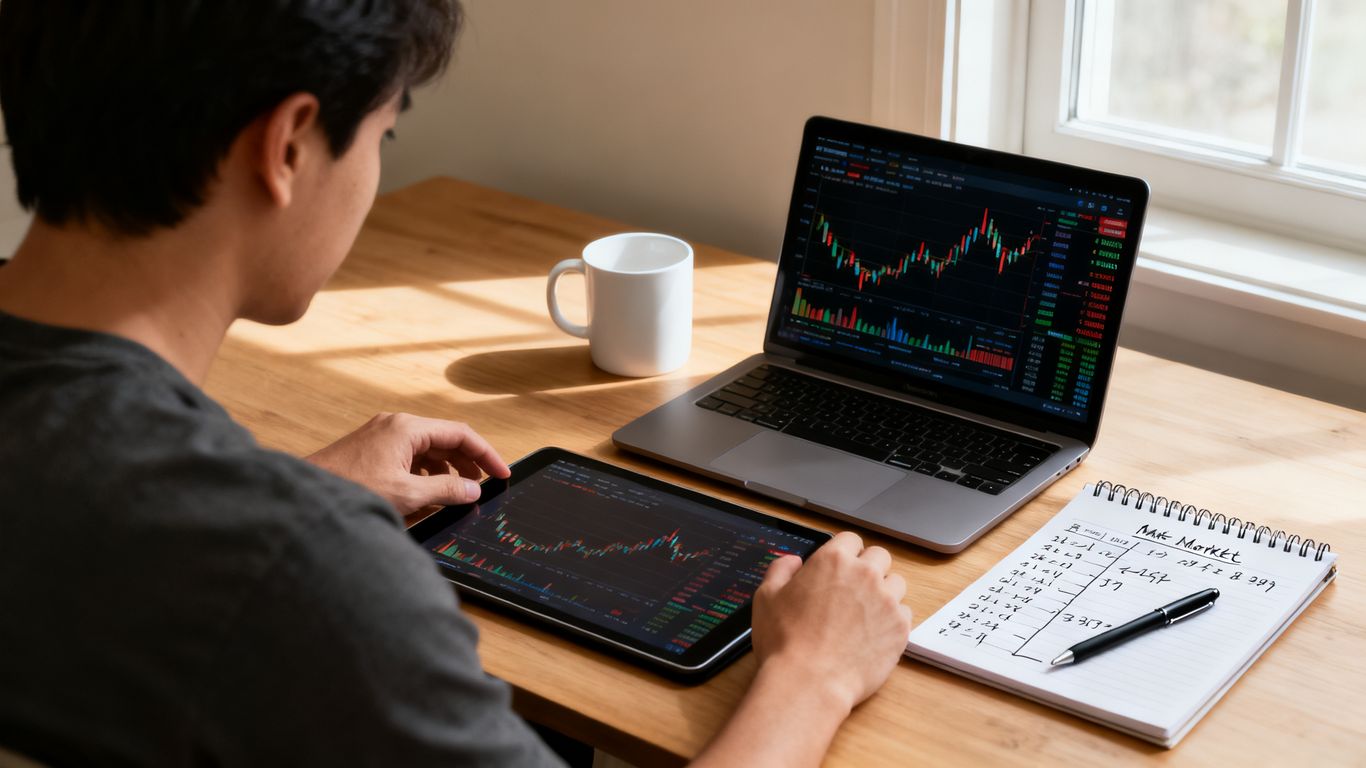
Compare markets by opening hours, volatility and costs
Market access and price activity are not the same thing. A market can be open for many hours but quiet at certain times, while another may concentrate activity around scheduled sessions or announcements. The table below is a simple way to frame the comparison; actual hours, volatility and costs depend on the instrument and provider.
| Market | Trading hours | What to check | Possible cost areas |
|---|---|---|---|
| Shares | Often linked to exchange sessions | Company news and session gaps | Commissions and spread |
| Forex | Commonly active across global sessions | Currency events and changing liquidity | Spread and overnight charges |
| Commodities | Varies by instrument and venue | Supply news and contract terms | Spread, commission and financing |
| Crypto | Often available around the clock | Sharp moves and venue-specific terms | Spread, fees and network costs |
Use the comparison to narrow your choices, not to predict which market will be profitable. Check the exact instrument specification and costs for the account you plan to use, then consider whether its active hours fit your daily schedule.
Check a provider’s fees, regulation and available instruments
Before opening an account, check who operates it, what regulatory protections apply in your location and which instruments are actually available. Read the fee schedule rather than relying on a headline spread: commissions, financing, conversion fees and other charges can affect the total cost. Make sure you understand what happens if a provider changes terms or you want to close the account.
If you are considering a funded evaluation rather than a personal brokerage account, read its rules just as closely. GoldFunding offers a Rapid one-step evaluation with a 10% profit target and a Classic two-step evaluation with targets of 10% and 5% across its phases; both have stated drawdown limits. That is a description of those evaluation terms, not a forecast of whether a trader will pass.
Understand demo, personal and funded evaluation accounts
A demo account lets you practise with simulated funds, which can help you learn order entry without risking real money. A personal trading account uses your own funds, so gains and losses affect your balance. A funded evaluation is different: you must meet the provider’s stated targets and limits before you can qualify for a funded account.
A simulation cannot fully reproduce the pressure of making decisions with real money, and evaluation rules are not the same as a broker’s account terms. If you are exploring an evaluation, compare evaluation options only after you understand the targets, loss limits, time conditions and any other rules that apply. Treat the rulebook as part of the product, not fine print to skim later.
Pick a market that fits your schedule and experience
A market can look attractive on a chart and still be a poor fit for your day-to-day life. If you can only check prices at set times, choose an approach and instrument that do not require constant monitoring. If you are new, keep the number of markets and variables small while you learn how orders and costs work.
For another perspective, look for trading planning ideas that help you make a routine around your own availability. Write down when you can prepare, place and review trades. That small bit of honesty about your schedule can prevent you from copying a style that does not suit you.
Build a simple trading approach
A trading approach is a set of repeatable decisions, not a promise that the market will behave as expected. It should explain what information you use, what would trigger an entry and what would show the idea is no longer valid. Start with rules you can describe plainly and test consistently.
Choose between technical and fundamental analysis
Technical analysis looks at price history and chart behaviour, while fundamental analysis considers economic, company or other underlying conditions. Some traders focus mainly on one, and others combine them; neither removes uncertainty. Your choice should fit the market and the time you have for research.
A simple method is to use broader context to understand what may be influencing a market, then use price behaviour to decide whether your planned conditions are present. Keep the two questions separate: what might explain the move, and what would make you act? This can help prevent a compelling story from becoming an entry signal on its own.
Learn how trends, ranges, support and resistance work
A trend describes a sequence of movement in one direction; a range describes price moving between areas where buyers and sellers have repeatedly responded. Support and resistance are zones traders watch, not barriers that price must respect. They can fail, and an apparent breakout can reverse.
Marking these areas can help you plan where an idea would make sense and where it would be invalidated. Avoid drawing so many lines that every price change seems significant. A chart is a tool for organising observations, not a map of what must happen next.
Set clear entry and exit conditions before placing a trade
Before entering, describe the setup, the price behaviour you need to see and the point at which your reasoning no longer holds. Then decide how you would exit if the trade moves in your favour, as well as if it moves against you. A written plan gives you something specific to assess afterwards.
A compact pre-trade sequence can keep those decisions in view:
- State the reason the setup meets your rules.
- Identify the entry condition and the level that invalidates the idea.
- Set a maximum acceptable loss and calculate the position size.
- Decide what would prompt an exit or a review.
Once these conditions are clear, do not change them simply because a price fluctuation feels uncomfortable. If the market no longer fits your original idea, follow the exit rule rather than inventing a new reason to stay in.
Test your rules on historical data and a demo account
Historical charts can show how your rules might have behaved in earlier conditions, but they cannot guarantee what happens next. Be alert to hindsight: a setup can look obvious after the outcome is known. Record assumptions and test enough examples to notice where the approach struggles, not just where it works.
You can then practise order placement and decision-making in a demo account. A trading simulator can provide a virtual setting for learning how orders and position direction work. Focus on whether you followed your rules, rather than treating simulated profits as proof that a strategy is ready for live use.
Plan trades and manage risk
Risk planning starts before you open a position. Decide what you can afford to lose, how that loss would be measured and what would make you stop for the day. A sensible plan leaves room for a run of losing trades without forcing you to abandon it under pressure.

Decide how much of your account to risk on each trade
There is no single risk amount that suits everyone, and a percentage is not a guarantee against loss. The useful principle is to choose a maximum in advance and keep the potential loss small enough that several unsuccessful trades would not immediately derail your plan. Your financial circumstances and the instrument’s behaviour matter.
GoldFunding’s evaluation rules specify a 5% daily loss limit and a 12% maximum overall drawdown for its tracks. Those limits describe the evaluation conditions, not a recommended amount for an individual trade. If you use any evaluation account, check how its provider calculates losses and what happens when a limit is reached.
Set stop-loss levels and calculate position size
A stop-loss is an instruction to close a position if price reaches a specified level, although the final execution price may differ in fast-moving conditions. Place it where your trade idea is invalidated, rather than choosing a level only because it produces a convenient size. Then calculate the position size using the distance to that stop and the amount you have decided to risk.
The calculation links three things: the maximum loss you accept, the distance from entry to stop and the value of each price movement for that instrument. Check the contract or instrument specifications before using a calculator, because those details differ. If the resulting position is too large for your account, reduce it or skip the trade.
Understand daily and overall drawdown limits
A daily limit concerns losses over a defined day, while an overall drawdown limit sets a wider boundary for the account or evaluation. Providers can define the calculation and reset time differently, so do not assume the rules are interchangeable. Read how open trades, closed trades and account balance are treated.
For an evaluation, note the exact threshold and what happens after a breach. These limits are constraints to plan around, not targets to approach. Leave a buffer for normal price movement and avoid placing a new trade when a small adverse move could end your session or account.
Avoid oversized positions and trading to recover losses
A large position can turn an ordinary price fluctuation into a serious account problem. After a loss, the urge to win the money back quickly can lead to rushed entries, greater size or ignored exit conditions. That response changes the plan just when you most need it to remain stable.
If you feel pulled towards a recovery trade, step away and review what happened before placing anything else. A missed opportunity is usually easier to absorb than a decision made outside your risk limits. Your process should still make sense after a losing trade, not only after a winning one.
Place and manage your first trades
When you are ready to place a trade, slow down enough to check the order details. The order type, costs and instrument specifications can affect what happens after you click. Practising the sequence on a demo account first can make it easier to spot mistakes.
Learn how market, limit and stop orders work
A market order seeks to execute promptly at the available price, which can differ from the price you last saw. A limit order sets a price condition for buying or selling, but it may not be filled. A stop order becomes active once its trigger price is reached, though the resulting execution can still vary in a fast market.
The right order depends on your plan and the instrument; no order type removes market risk. Before submitting, check the direction, size, price condition and any attached stop or exit. If one detail is unclear, pause and consult the platform’s instructions rather than guessing.
Check spreads, commissions and overnight charges
The spread is the difference between the displayed buy and sell prices. A commission may be charged separately, and holding a position overnight can involve financing or other charges depending on the instrument and provider. These costs can change the result of a trade, particularly when you trade frequently or hold for longer.
GoldFunding runs on MatchTrader, according to its product information. Whatever platform you use, check the instrument details and account fee schedule before opening a position, including any charges for holding it. A clear estimate of costs helps you compare the trade’s potential outcome with its possible downside.
Manage open trades without reacting to every price move
Once a position is open, short-term fluctuations can tempt you to interfere with a plan that was made more calmly. Keep the trade’s original conditions visible and act when one of them changes, rather than reacting to every tick. If you need to adjust a stop or exit, be clear about what new information justifies the change.
A planned exit is not a failure if the market moves against your idea; it is part of controlling the decision. Equally, a favourable move does not automatically mean you should add to a position. Let your written rules, not the emotional intensity of the moment, guide the next step.
Record your reasoning and results in a trading journal
A journal helps you see whether outcomes came from a sound process or from a one-off result. Record the market, setup, entry and exit, planned risk, actual result and any rule you broke. Add a short note about what you were thinking before and during the trade, while the details are still fresh.
Keep the record factual and concise. A useful entry explains what you saw and what you did, not just whether you won or lost. Over time, those notes can reveal patterns that a balance figure alone would hide.
Review progress and improve steadily
One trade is too small a sample from which to judge an approach. Review a series of trades and look for patterns in both the results and your execution. This gives you a better basis for deciding what to keep, change or practise next.
Assess performance across a series of trades
Look at a meaningful group of trades rather than focusing on the most recent win or loss. Consider whether you followed your rules, how losses compared with your planned risk and whether the same types of setups behaved differently. A profitable period can still include poor decisions, just as a losing period can include careful execution.
Separate process from outcome when you review. A single result is not proof that a decision was good or bad; ask whether it made sense using the information available at the time. This distinction helps you learn without rewriting your rules around a lucky or unlucky trade.
Identify mistakes, rule-breaking and emotional decisions
Review your journal for repeated problems such as entering too early, moving a stop without a clear reason or increasing size after a loss. Note the circumstances around them: time of day, market conditions, fatigue or pressure to make a particular amount. A specific observation is more useful than labelling yourself undisciplined.
Then choose one behaviour to watch on your next set of trades. If the same mistake appears again, look for a practical adjustment, such as a pre-trade check or a shorter session. The point is to change the conditions around a decision, not to rely on willpower alone.
Adjust one part of your approach at a time
If you change your entry rule, stop placement and market at once, it becomes difficult to know which change mattered. Make one adjustment, write down why you are making it and observe how it works across a reasonable sample. Keep the rest of the approach stable while you assess the effect.
A change should address an identified weakness, not simply follow a disappointing result. Retest the revised rule where practical, then practise it in a demo account before using real funds. Small, deliberate adjustments are easier to evaluate than a complete rewrite after every rough patch.
Know when to pause, practise or seek further guidance
Pause if you are tired, upset or tempted to break your own limits. Practise if you are still uncertain about orders, position size or how your rules behave in different conditions. If you need help understanding an account’s terms, consult its provider or a suitably qualified professional rather than relying on a guess.
For more learning, explore material that explains the mechanics and risks of your chosen market. Keep expectations realistic: more reading does not remove uncertainty, and no source can promise a profitable outcome. Return to live decisions only when you can explain your plan and its limits clearly.
Explore funded trading options
If you have a tested approach and want to learn about an evaluation route, GoldFunding describes its Rapid and Classic paths for traders seeking to qualify for a funded account. Review the rules carefully before you decide to explore funding options.
Conclusion
Learning how to trade for beginners is less about finding a perfect signal and more about building a repeatable way to make and review decisions. Choose a market you can understand, plan risk before entry and give your approach time to prove itself across many trades. Progress is steadier when you protect your ability to keep learning.
Frequently Asked Questions
How much money do you need to start trading?
It depends on the market, instrument and provider, so there is no universal minimum. Check account requirements and costs, and only use money you can afford to lose.
Can you learn trading with a demo account?
Yes. A demo account can help you practise orders and test a routine without risking real funds, though simulated trading cannot fully reproduce the experience of losses on a live account.
What is the difference between a market and a limit order?
A market order seeks prompt execution at an available price, while a limit order sets a price condition and may not be filled. Each has trade-offs, and neither removes the risk of loss.
Is leverage suitable for beginners?
Leverage can increase both gains and losses relative to the cash committed. Make sure you understand how the instrument is sized and how a price move could affect your account before using it.
How do you choose a market to trade?
Compare its opening hours, volatility, costs and the time you can give it. Start with a market whose basic mechanics you can explain and whose activity fits your schedule.
What should a trading plan include?
A plan should state the conditions for entering and exiting, what invalidates the trade, how you will size the position and the maximum loss you accept. It should also explain when you will stop trading and review your results.
How many trades should you review before changing a strategy?
There is no fixed number that suits every approach, but one or two trades are rarely enough to reveal a pattern. Review a consistent sample and change one part of your process at a time.